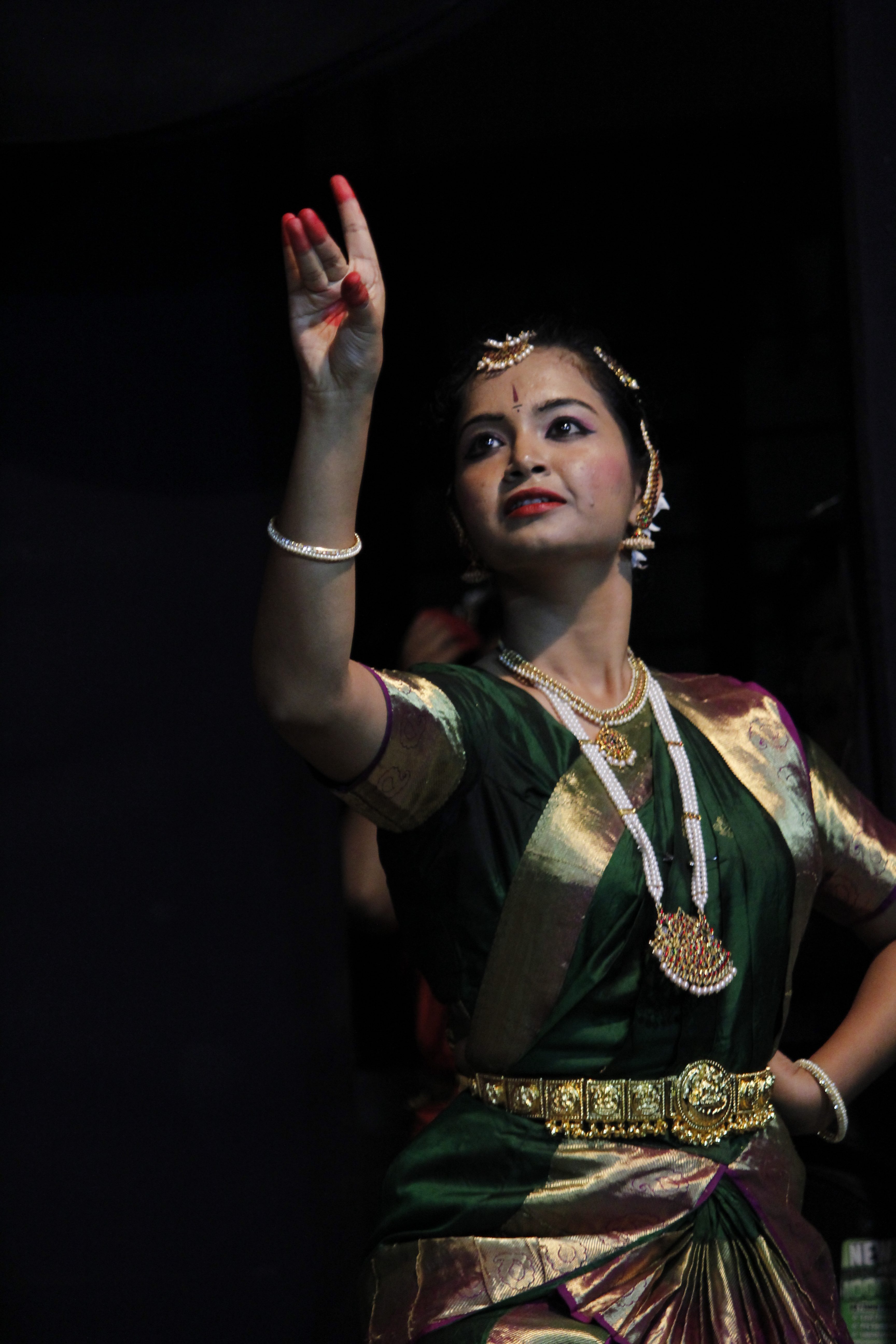
Ever since the day I stepped into the dance class as a 6-year-old toddler, Bharatanatyam has been an integral part of my life. From learning Adavus to understanding Abhinaya, from struggling to perform Karanas to experiencing the joy of choreography, dance has taught me to evolve as a human being in a thousand different ways.
And this learning has not stayed within the boundaries of the dance class. It has seeped into my academic and professional outlook as well, helping me look at professional problems from a unique perspective. It has pushed me to tackle challenges in innovative ways, to search for a solution by changing the parameters of the problem, similar to how the permutations of a Tirmanam might differ for a Jati, even if the Tala remains the same!
On the career front, I work as a Content Marketer – a job that primarily concerns writing articles, blogs, and all forms of digital content to aid marketing. Given that words and dance have had a close relationship since eons, I feel fortunate to work in an industry that has so many parallels with my hobby!
Building on that premise, I would like to elaborate on a few direct correlations here of how dance has guided my professional steps and, in turn, how content marketing has influenced my perspective as a dancer!
Bhava – Abhinaya: Leveraging the Power of Expression in Writing
“The essence of dance is the expression of man – the landscape of his soul.” – Martha Graham
Abhinaya, or the art of expression, is one of the core elements of Bharatanatyam, as described in Nandikeshwara’s Abhinaya Darpanam.
It is that which takes the audience on a journey towards understanding the root of the lyric or music to which it is performed.
As a student, I had always tried to master Abhinaya for the sake of improving my performance. However, as I started working as a content marketer, I understood the true depth of Abhinaya and its nuances.
In essence, Abhinaya is all about visualizing yourself as the character and depicting the emotions of the character as if they were your own. In content marketing, the situation is no different! I often have to put myself in the shoes of my readers to gauge if they would find the article interesting or boring, or, in other words, visualize myself as my reader and then write the article!
At such junctures, the lessons I had learned since childhood come in handy, and I am easily able to relate to my reader and create an engaging article.
The true master of Abhinaya also understands the importance of elaborating crucial points with finesse and switching expertly between characters so the audience can comprehend the entire story.
Case in point: I once had to play eight different characters for Solo – a poem I had written and choreographed for an independent performance.
I often apply Bharatanatyam’s conventional format of Padartha – Vinyasa – Sanchari to my articles, by first explaining the concept in brief and then gradually elaborating it throughout the article. And it works! Many times, I have received positive feedback about how well the concept was explained in the article, and I attribute that success to dance.
In addition, I am able to easily switch between the reader and myself as a writer, because I am used to doing so in the Padams and Varnams I have learned!
Learning Abhinaya has given me the ability to express myself equally well in multiple mediums, for the emotion is essentially the same; only the form of expression is different.
Nayak – Nayikas: Understanding Psychology for Marketing

The study of the Nayakas (male lead character) and Nayikas (female lead character) in classical dance is an essential requirement for every dancer so she can portray their complexities with ease in her performance.
Bharatamuni’s Natyashastra categorizes the Nayakas and Nayikas broadly by temperament, deed, and emotional state of mind. However, as we start to dig deeper, we realize that we cannot characterize a Nayika by using just one label. She has as many shades as a rainbow, each slightly merging into her final state of mind, i.e., Sthayibhava, which becomes the category of her classification.
Understanding these transitions of the Nayika’s state of mind is closely related to the study of psychology, which also reflects in customer psychology in content marketing.
Studying the Nayikas in their myriad moods has given me the understanding of how I can take the reader through varying emotions of curiosity, anticipation, fear, and happiness in the duration of the same article, even while keeping the core emotion of gaining knowledge consistent.
The heroes and heroines of Bharatanatyam are classic representations of the customer personas in content marketing, and the parallels between the two have given me a much deeper insight into how I can create engaging content for my readers.
Nava Rasa: The Emotions that Influence Readers

Humans are creatures of emotion. We are defined by our ability to experience and express emotion and, as a dancer and writer, I find this particularly important. There is no greater joy for a dancer than the generation of an aesthetic experience, i.e., rasanishpatti, in the hearts of her audience through her performance. Similarly, there is no greater joy for a writer than being able to evoke the emotions she desires in her readers through her words!
I remember the time when I was supposed to write an article about a product we were going to stop selling. The tone was supposed to be sad, yet hopeful towards the end. So, I imagined myself to be the beloved of a warrior who was about to depart for battle, thereby fixing in my head the Karuna (sad), Veera (warrior), and Smita Hasya (in this context, feeling of pride in his decision to serve the nation) rasas, as she bade him farewell! This helped me capture the exact tone that was expected for the article, although the context was entirely different!
This in-depth understanding of Rasa (core emotion), Bhava (shades of the core emotion), and Rasanishpatti (the aesthetic experience) has helped me many a time in anticipating how a concept needs to be presented so my readers can relate to it immediately, a trait I could develop only because of dance.
Tala and Laya: Adding Rhythm to Content
Rhythm, or Tala, is the soul of music, and music is the lifeblood of dance. Exploring the intricacies of beats while sticking to the boundaries of the rhythmic cycle is something every avid dancer enjoys, and I am no exception. I had been acquainted with the rhythms of dance since childhood, but only recently did I discover the rhythms in prose as well.
People usually think that rhythms and metres are limited to poetry when it comes to writing, but nothing could be further from the truth!
I believe a well-written article is like a perfectly choreographed rhythmic cycle; every word is in its proper place, and the whole sentence glides smoothly in the mind of the reader. There is no jarring break or misplaced beat to mar the impact of the article either!
As Bharatanatyam has its Talas and Layas, so does content writing have its own rhythm, which I discovered only because of dance.
Creativity and Presentation: The Twin Pillars of Dance… and Marketing

Any dancer worth her anklets would agree that dance is the ultimate test of creativity and presentation. As a choreographer, you look at the world from a different perspective than normal people, finding formations and patterns that you would not have seen otherwise. As a dancer, you bring these patterns to life through presentation, with dedication and rigorous practice.
For instance, I once choreographed Bharatanatyam to Richard Wagner’s Götterdämmerung, where I tried to depict the parallels between the end of the world as described in Indian and Norse mythology. I won’t go into too many details here, but there are some striking similarities between the Pralaya of the Kaliyuga and the Twilight of the Gods, marking the end of all human civilization.
Having said that, creativity and preparation may all be very well, but what matters ultimately is the show.
You can never tell what last-minute hiccups may occur or what adjustments you might need to make. The important thing is not to crack under the pressure. Many a time, when things seemed to be on the verge of going wrong right before a show, my teacher would calmly assess the situation and find an impromptu but effective solution.
People in the corporate field pay thousands of rupees to learn these values of creativity, practice for impeccable presentation, and a problem-solving approach; things I got to learn involuntarily as a part of my dance instruction!
In my professional life, these values have been infinitely helpful in shaping my work vision. Dance is a never-ending font of creative inspiration for me, and it constantly motivates me to try new and varied approaches while writing any content piece.
The Last Word
To say Bharatanatyam has simply influenced my career would be an understatement.
It has shaped, pruned, and elevated my work as a content marketer and profoundly changed me as a human being.
Today, dance is not just an integral part of my life, but also of my career, and it strengthens my work to a huge extent!
Time and again, I have drawn inspiration from the concepts of Bharatanatyam to fuel my creativity in content marketing. I have used the principles of performance to shape the presentation of my content and derived some of my most aesthetically appealing work from the precepts of Aharya.
I can confidently say dance was, is, and will continue to be a very important part of my personal and professional life, for as someone has truly said – dance is not just an art form, it is a way of life!


